If you’re renovating your kitchen or bathroom, chances are you’ve landed on two main contenders for countertops: quartz and granite. Both are popular, both look gorgeous, and both come with a hefty price tag compared to laminate or tile. But they’re actually pretty different once you dig into the details, and picking the wrong one for your lifestyle can lead to some regret down the road.
So let’s break down exactly how quartz and granite compare, so you can make a decision that actually fits your home and how you live in it.
What’s the Difference Between Quartz and Granite?
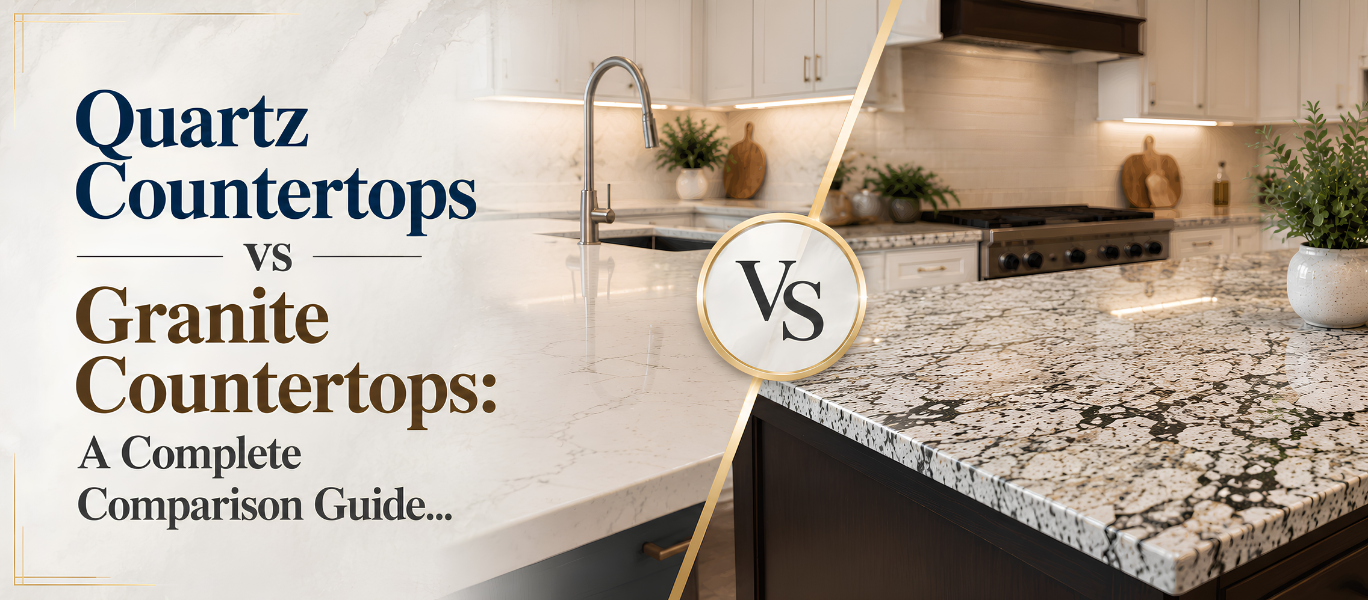
Granite is a natural stone. It’s mined from quarries, cut into slabs, and polished, so every single piece is unique with its own veining, colour variation, and pattern. No two granite countertops will ever look the same, which is part of their appeal for a lot of homeowners.
Quartz, on the other hand, is an engineered stone. It’s made by combining crushed quartz crystals (around 90-95%) with resins and pigments, then compressed into slabs. Because it’s manufactured, quartz offers much more consistency in colour and pattern, and it can even be designed to mimic the look of marble or granite if that’s the style you’re after.
This core difference, natural versus engineered, is really what drives most of the other distinctions between the two materials.
Durability: Which One Holds Up Better?
Both quartz and granite are seriously durable, but they handle wear and tear a bit differently.
Granite is extremely heat-resistant and can handle hot pots and pans directly on the surface without much worry, though it’s still smart to use a trivet just to protect the sealant. It’s also very scratch-resistant, though it can chip if hit hard enough with something heavy or sharp.
Quartz is also tough, but it’s slightly more sensitive to heat because of the resin used in manufacturing. Setting a hot pan directly on quartz can cause discolouration or even cracking over time, so trivets are pretty much mandatory here. On the plus side, quartz is non-porous, which makes it more resistant to scratches and chips in everyday use.
If heat resistance is your top priority, granite has a slight edge. If you want something a bit more forgiving with impacts and daily kitchen chaos, quartz tends to perform a little better.
Maintenance: Which Requires More Work?
This is where quartz really pulls ahead for a lot of homeowners.
Granite is porous, which means it needs to be sealed periodically, usually every one to three years, to prevent stains and bacteria from soaking into the stone. It’s not a huge task, but it is something you have to stay on top of.
Quartz doesn’t need sealing at all. Since it’s non-porous, spills sit on the surface and wipe away easily without soaking in. This makes it a pretty low-maintenance option, especially for busy households or rental properties where regular upkeep might get overlooked.
If you’re looking for a “clean it and forget it” countertop, quartz is the clear winner here.
Look and Style: Which One Wins Visually?
This one really comes down to personal taste, since both materials offer stunning options.
Granite’s biggest selling point is its natural uniqueness. Every slab has its own character, and if you love the idea of a countertop that’s genuinely one-of-a-kind, granite delivers that in a way engineered stone simply can’t replicate.
Quartz offers more consistency and control. Since it’s manufactured, you can choose from a huge range of colours and patterns, including options that mimic marble’s soft veining or granite’s natural speckling, but with more uniformity across the whole slab. This makes quartz a great option if you’re trying to match a very specific design vision or need multiple slabs to look identical for a large kitchen island or multiple bathrooms.
If you’re leaning toward granite for its natural uniqueness, you can browse a variety of slabs and styles at Quality Granite USA to find one that fits your space.
Cost Comparison
Pricing for both materials varies quite a bit depending on the specific type, brand, and where you live, but here’s a general breakdown.
Granite typically ranges from around $40 to $100 per square foot installed, with rarer or more exotic varieties costing significantly more.
Quartz tends to fall in a similar range, roughly $50 to $100 per square foot installed, though premium quartz brands can push costs higher.
At a glance, the two materials are often pretty comparable in price, though this can shift depending on availability in your area and the specific style you choose. It’s worth getting quotes for both before assuming one is definitely cheaper.
Environmental Considerations
Granite, being a natural stone, requires quarrying, which does have an environmental footprint, though it’s a naturally occurring material that doesn’t need much processing beyond cutting and polishing.
Quartz involves more manufacturing since it combines crushed stone with resins, which adds an industrial component to its production. However, many manufacturers now offer eco-friendly quartz options made with recycled materials, so this gap has narrowed over the years.
If sustainability is a major factor in your decision, it’s worth researching specific brands and their sourcing practices rather than making a blanket assumption about either material.
Which One Should You Choose?
Honestly, there’s no universal right answer here; it really depends on your priorities.
Choose granite if you want a truly unique, natural look, don’t mind occasional resealing, and want strong heat resistance for a busy kitchen.
Choose quartz if you prefer low maintenance, want more consistency in colour and pattern, and don’t want to worry about sealing schedules.
Final Thoughts
Both quartz and granite are excellent countertop choices that can last for decades with proper care. The decision ultimately comes down to how much maintenance you’re willing to do, the exact look you’re going for, and your budget.
Whichever material you choose, working with an experienced supplier like Quality Granite USA can help you get expert guidance, quality slabs, and professional installation.
FAQ’s
-
Is quartz or granite better for kitchen countertops?
Both are excellent choices, but the better option depends on priorities. Granite offers natural, one-of-a-kind beauty and strong heat resistance, while quartz offers lower maintenance since it doesn’t require sealing.
2. Which is more expensive, quartz or granite?
Quartz and granite are often similarly priced, typically ranging from $40 to $100 per square foot installed for granite and $50 to $100 per square foot for quartz, though exact costs vary by brand, rarity, and location.
3.Does quartz scratch or chip more easily than granite?
Quartz is generally more resistant to everyday chips and scratches due to its non-porous, engineered composition, while granite is highly scratch-resistant but can chip if struck hard with a heavy or sharp object.
4.Can you put a hot pan directly on granite or quartz?
Granite can typically handle direct heat from hot pots and pans, though a trivet is still recommended to protect the sealant. Quartz is more heat-sensitive due to its resin content, so trivets are essential to prevent discolouration or cracking.
5.Does granite need more maintenance than quartz?
Yes, granite is porous and needs to be sealed every one to three years to prevent staining, while quartz is non-porous and does not require sealing at all.