White quartzite countertops promise the soft, airy look of marble with the toughness of a harder stone. That promise explains why homeowners keep searching for them. It also explains why the choice feels hard, because white quartzite slabs look similar in photos and differ a lot in person.
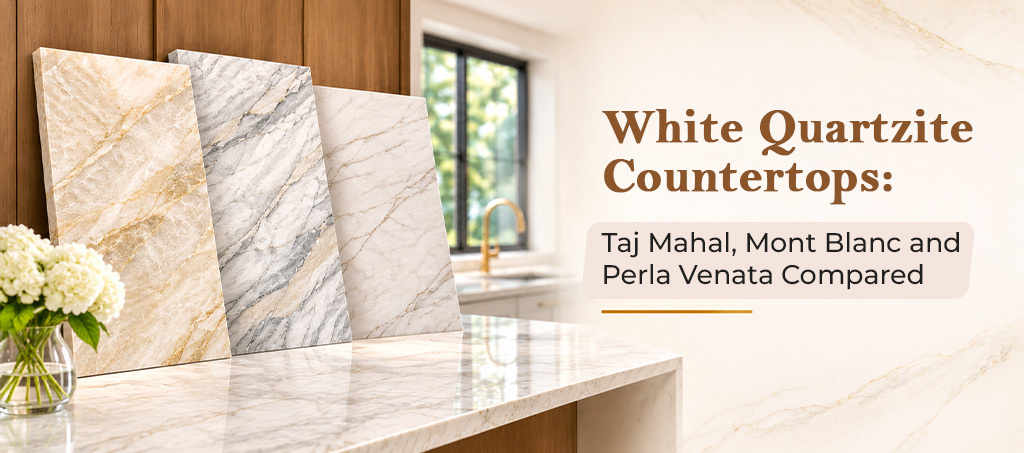
This guide compares three popular options: Taj Mahal, Mont Blanc and Perla Venata. You’ll learn what separates them, how to judge undertone and veining, and how to confirm you’re buying a true quartzite. Then you can walk into the showroom with a clear shortlist.
What are white quartzite countertops?
White quartzite countertops are natural stone surfaces cut from quartzite slabs in white, cream or very light gray tones, usually with soft veining. Quartzite forms when sandstone transforms under intense heat and pressure, which gives it a dense, hard structure. Because it is a natural stone, each slab has its own pattern and color shifts.
Most homeowners choose white quartzite for three reasons. It delivers a bright, high-end look. It tends to be harder than many other natural stones. And it handles heat and daily kitchen use well. Quartzite is not maintenance-free, though, and we’ll cover care shortly.
Why choose white quartzite over other white countertops?
Other white options exist, so it helps to know where quartzite fits.
- Compared with marble: White quartzite offers a similar veined beauty, and quartzite is generally considered more resistant to scratching and etching. Confirm the performance of your exact slab with your fabricator.
- Compared with white granite: Quartzite often has softer, more flowing veining, while many white granites show a more speckled texture.
- Compared with engineered quartz: Quartzite is natural, so every slab is one of a kind. Engineered surfaces offer more consistency instead.
If you want a natural stone with a calm, luminous look, white quartzite deserves a place on your shortlist. Browse the full quartzite collection to see the range.
Wondering how quartzite differs from engineered quartz? Our quartz vs quartzite comparison explains the differences in durability, heat and upkeep.
How do Taj Mahal, Mont Blanc and Perla Venata compare?
All three read as “white quartzite,” but they carry different personalities. Use the table as a starting point, then confirm each slab in person, because natural stone varies from slab to slab.
| Feature | Taj Mahal | Mont Blanc |
| Overall feel | Warm, soft and creamy | Crisp, bright and cooler |
| Undertone | Leans warm (cream, beige, soft gold) | Leans cool (white and gray) |
| Veining | Gentle, flowing | Defined gray movement |
| Pairs well with | Warm wood, brass, cream or white cabinets | Gray, navy or white cabinets, chrome or black fixtures |
| Best for | Cozy, timeless kitchens | Clean, contemporary spaces |
The descriptions above reflect how these slabs are commonly described, but each batch of stone differs. Check the current slab photos on each product page before you decide.
Taj Mahal quartzite
Taj Mahal is a favorite for homeowners who want white without the chill. Its warm cream and soft beige tones feel welcoming, and its gentle veining keeps the surface calm. It pairs naturally with wood floors, warm metals and white or cream cabinetry. If your kitchen gets little daylight, the warmth can make the room feel brighter and softer.
Watch the undertone, though. A warm slab can look yellow next to a cool, bluish white cabinet. Hold a cabinet sample against it before you commit. For a deeper look at this slab, read the Taj Mahal quartzite page.
Mont Blanc quartzite
Mont Blanc suits homeowners who prefer a crisp, clean palette. Its cooler white and gray character reads as modern and fresh, and its veining adds definition without overwhelming a room. It works especially well with gray or navy cabinets and with chrome, nickel or black hardware.
Its cooler tone can feel stark in a dimly lit kitchen. Check it in the lighting you actually have. See the Mont Blanc quartzite slab for current details.
Perla Venata quartzite
Perla Venata rounds out the trio as a white quartzite with its own character. Its undertone and veining vary from slab to slab, so judge it by the actual piece rather than a photo. Place it beside Taj Mahal and Mont Blanc in the showroom, and compare warmth, veining and how it reads in your own light.
Explore the Perla Venata quartzite slab to see how it looks across different lighting and layouts.
How do you choose between white quartzite slabs?
Follow these steps to narrow your choice without second-guessing.
- Decide warm or cool first. Warm undertones feel cozy. Cool undertones feel crisp.
- Pick your veining level. Do you want quiet movement or dramatic lines? Dramatic veining makes a statement, while soft veining blends in.
- Test it in your light. North-facing rooms read cooler, and south-facing rooms read warmer. View slabs near a window if you can.
- Compare against your cabinets and floor. Bring samples. Undertones clash more often than they match by accident.
- View the exact slab. Natural stone varies, so look at full slabs rather than small samples whenever possible.
How can you be sure it’s true quartzite?
This question matters more than most buyers realize. In the stone industry, some natural stones sold under the “quartzite” label behave more like softer stones, such as marble or dolomite. Naming practices vary, and a soft stone sold as quartzite can etch or scratch more than you expect.
Protect yourself with these steps:
- Ask the supplier directly how the slab is classified and how it performs.
- Ask for a care sheet specific to your slab.
- Ask about testing. Reputable fabricators can explain how they check a stone’s behavior with acids and scratches. Avoid testing a finished countertop yourself.
- Request a sample and test it with your own cleaning habits where possible.
How do you care for white quartzite countertops?
White stone shows spills more visibly than darker stone, so good habits pay off.
- Seal as recommended. Most quartzite benefits from a sealer, and your fabricator can tell you how often.
- Wipe spills fast, especially oil, wine, coffee and tomato sauce.
- Use a gentle cleaner made for natural stone, and skip harsh, acidic or abrasive products.
- Use trivets and cutting boards. Quartzite tolerates heat and cutting better than many surfaces, but boards protect both your knives and the finish.
A simple water test helps you spot when sealing is due. Drop a little water on the surface. If it darkens the stone and soaks in, reseal.
What affects the cost of white quartzite countertops?
Quartzite typically sits above entry-level materials, and prices vary widely between slabs. Several factors shape your final estimate:
- The specific slab, its rarity and its grade
- Square footage and layout
- Thickness and edge profile
- Number of seams and cutouts
- Installation conditions
Rather than guessing, request a written estimate based on your measurements through the quote page.
What kitchen designs suit white quartzite?
White quartzite adapts to many styles. A few combinations work especially well:
- Classic white kitchen: White cabinets, brass hardware, warm wood floors.
- Modern gray and white: Slate or charcoal cabinets, black fixtures, clean lines.
- Two-tone kitchen: Dark lower cabinets with white quartzite counters and a light upper run.
- Statement island: Use a bold, veined slab on the island and keep the perimeter simple.
FAQs about white quartzite countertops
Is white quartzite better than marble?
Many homeowners choose white quartzite because it generally resists scratching and etching better than marble. Performance still depends on the specific slab, so confirm with your fabricator.
Does white quartzite stain?
Quartzite can absorb liquids if left unsealed. Sealing and quick cleanup reduce the risk.
Which is the best white quartzite for a kitchen?
There is no single best choice. Taj Mahal leans warm, Mont Blanc leans cool, and Perla Venata offers a third option. Match the slab to your cabinets, lighting and style.
Can white quartzite handle hot pans?
Quartzite generally tolerates heat well, but trivets still protect the surface and the sealer.
Do all quartzite slabs look the same?
No. Natural variation means color, movement and veining change from slab to slab, even within the same named stone. View the slab that will become your countertop.
Find your white quartzite
Picking among white quartzite countertops comes down to undertone, veining and light. Compare Taj Mahal, Mont Blanc and Perla Venata in person, hold your cabinet sample beside them, and ask how each slab has been classified and tested. When you’re ready to see them, request white quartzite samples and our team will help you build your shortlist.